


Never Let a Good Crisis Go to Waste: Turning Economic Uncertainty into Business Opportunity

There is a well-known saying in business:
“Never let a good crisis go to waste.”
It can sound a little opportunistic. But I don't believe it means taking advantage of difficult circumstances.
I think it means using challenging conditions as a catalyst to make your business better.
And right now, there is no shortage of challenges for Australian businesses.
Consumers remain cautious. Costs are elevated. Inflation continues to put pressure on both businesses and households. Interest rates, wages, energy costs and broader global uncertainty are influencing decisions. Customers are thinking harder about where they spend their money, and businesses are having to work harder to protect their margins.
For business owners, it is easy to look at this environment and think:
"We just need to get through it."
But what if that isn't the best question?
What if the better question is:
"What is this environment giving me permission — or forcing me — to change?"

Good Times Can Hide Problems
When revenue is growing and cash is flowing, businesses can carry a surprising amount of inefficiency.
An unprofitable service line can be subsidised by another part of the business.
Poor processes can be solved by adding another person.
Pricing that hasn't kept pace with costs can be masked by increasing sales.
Underperforming employees can remain because there isn't an immediate reason to address the issue.
Technology investments get postponed.
Cash flow management becomes reactive rather than planned.
And strategic decisions are often replaced by operational busyness.
When conditions tighten, those weaknesses become much harder to ignore.
That can be uncomfortable.
But it can also be incredibly valuable.
Because a difficult market has a way of showing you where the business really works — and where it doesn't.
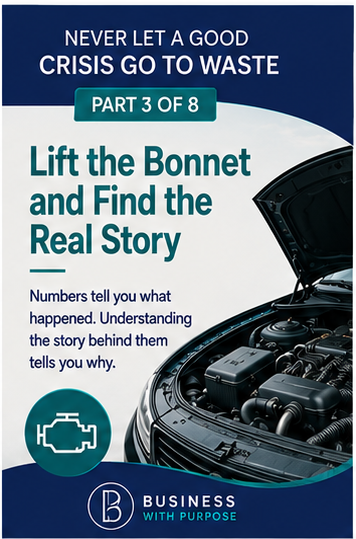
This Is the Time to Lift the Bonnet
One of the things I talk about regularly with my clients is understanding the story behind the numbers.
A profit and loss statement tells you what happened.
It doesn't necessarily tell you why it happened.
That requires curiosity.
If revenue has fallen, why?
Is it fewer customers? Lower transaction values? Pricing? Conversion? Customer retention?
A particular service line? A change in the market?
If wages have increased, is that necessarily a problem?
Perhaps productivity has increased with them. Or perhaps revenue per employee has fallen and the structure of the team needs to be reconsidered.
If gross margin is deteriorating, where exactly is it happening?
If cash is tight despite the business being profitable, where is the cash going?
These are the conversations I believe businesses need to be having now.
Rather than simply cutting costs across the board, lift the bonnet and understand the mechanics of the business.
Find the levers that actually drive performance.

Don't Just Cut. Reallocate.
One of the biggest mistakes businesses can make during uncertain periods is assuming that the answer is simply to spend less.
Sometimes costs absolutely need to come out.
But indiscriminate cost cutting can damage the very capabilities the business will need when conditions improve.
The better question is:
Where should we stop spending — and where should we invest more?
You might discover that a long-standing product or service is consuming resources without generating an appropriate return.
You might find manual processes that could be automated.
You might identify customers who generate significant revenue but very little margin.
There may be opportunities to restructure roles, renegotiate supplier arrangements or rethink how work moves through the business.
And there may be areas — technology, business development, key people or customer experience — where increasing investment now could position the business significantly better for the future.
A crisis shouldn't automatically trigger retreat.
Sometimes it should trigger reallocation.

Look Beyond Your Own Business
Challenging economic conditions don't only change your business.
They change the market around you.
Competitors may pull back.
Some may leave the market entirely.
Good people may become available.
Suppliers may become more willing to negotiate.
Customers may reconsider established relationships.
Acquisition or partnership opportunities may emerge.
And businesses with strong balance sheets and access to capital may find opportunities that simply weren't available when everyone was growing.
This is why I encourage business owners not only to ask:
“How do we protect ourselves?”
but also:
“What opportunities could this environment create for us?”
Defence and opportunity should be part of the same strategic conversation.
Cash Gives You Choices
Of course, opportunity is difficult to pursue if you don't understand your financial position.

This is where cash flow forecasting and scenario planning become particularly important.
Not because a forecast can predict exactly what will happen — it can't.
Its value is that it allows you to understand what could happen and what you would do about it.
What happens if revenue falls by 10%?
What if margins tighten by another 2%?
What if a major customer leaves?
What if you need to invest $100,000 to take advantage of an opportunity?
How much working capital does the business actually need?
How long is your runway?
And importantly:
At what point would you need to act?
The earlier you understand those answers, the more choices you generally have.
Waiting until cash becomes a problem turns strategic decisions into urgent ones.
Strategy Matters Most When the Answer Isn't Obvious

When markets are strong, businesses can sometimes succeed despite imperfect strategy.
When conditions become difficult, clarity becomes far more important.
Where are we going?
What are we trying to protect?
Where are we prepared to take risk?
Which customers do we really want?
Which products or services generate the greatest value?
What capabilities will we need in two or three years?
What should we stop doing?
And what opportunities are we prepared to pursue?
These aren't purely financial questions.
But the numbers help us answer them.
Finance should not sit separately from strategy.
The numbers should tell us whether the strategy is working, where it isn't working and where the opportunities may be hiding.
That is the role I increasingly play with my clients.
It is not simply producing reports or reviewing last month's P&L.
It is bringing together finance, operations, strategy and governance to understand the business as a whole.
It is asking questions.
Challenging assumptions.
Understanding the story behind the numbers.
And helping business owners turn that understanding into action.
Don't Waste the Opportunity
Nobody asks for difficult economic conditions.
But history tells us that periods of disruption often force businesses to make decisions they should perhaps have made years earlier.
They simplify.
They become more disciplined.
They understand their customers better.
They improve their systems.
They sharpen their strategy.
They protect cash.
They challenge assumptions.
And sometimes, while others are retreating, they find an opportunity to grow.
So perhaps the question for business owners right now isn't:
“When will things get better?”
Perhaps it is:
“What can I make better while things are difficult?”
Because economic conditions will eventually change.
And when they do, the businesses that emerge strongest won't necessarily be the ones that simply survived the crisis.
They'll be the ones that used it.
Business with Purpose | The Story Behind the Numbers
I work with business owners and leadership teams to look beyond the financial statements and understand what is really driving performance — bringing together finance, operations, strategy and governance to build stronger, more sustainable businesses.
Book a Free Consultation with Tamzin Weller Today


Comments